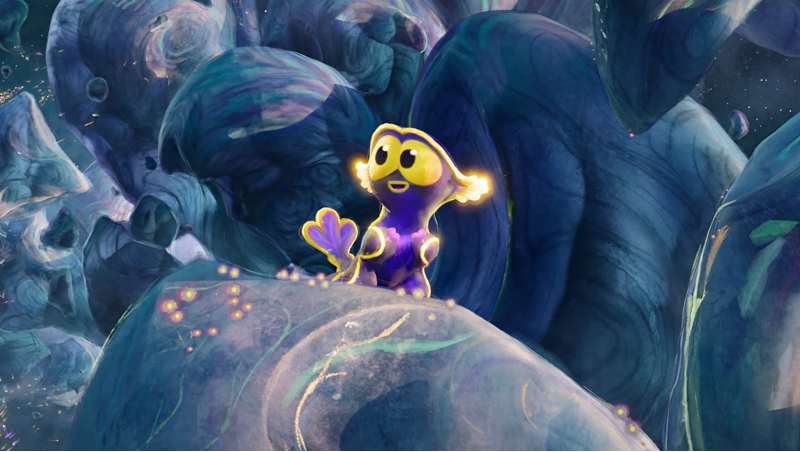
Each year, Blender Studio creates an animated film to showcase the capabilities of what is arguably the world’s most popular 3d animation software: Blender. This year’s project is called Singularity, and it’s the story of set in a distant age of the universe, when the stars and galaxies were young. When an ominous cosmic event swallows the icy home of a small space critter, he must find refuge among a group of luminous creatures watched over by a mysterious celestial being.
Like Blender itself, Blender Studio’s projects are all open source, and created by contributors from all over the world.
Directed by Andy Goralczyk, this short film was created using the latest, in-development version of Blender. While working on Singularity, the Blender Studio team expanded the Brushstroke Tools library by adding new painterly assets, and explored the procedural power of Geometry Nodes for animating crowd behavior.
Art Director Vivien Lulkowski based the artistic style of Singularity on watercolor illustrations. The strong traditional media influence seen in the hand-crafted textures and brush strokes is intertwined with generative effects and simulations. The creatures of this universe and their ecosystem feel vibrant and organic, in stark contrast to the threatening angular shape of the Black Hole.
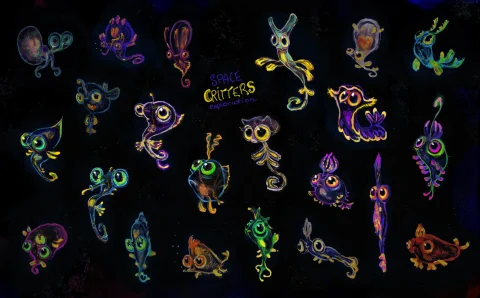
Mysterious and colorful creatures of the deep sea served as the main source of inspiration behind the energy-driven space critters. Critter, our lovable protagonist – part tardigrade, part axolotl, part gummy bear – is a small and vulnerable creature, barely able to outrun the Black Hole. Looming in the background is the enormous jellyfish, The One, a mix of octopus, plants and various other invertebrates. Its energy gives the creatures a chance to break free, illustrating how life thrives with the most unlikely alliances.
Aiming to create a film that speaks to everyone, regardless of background or language, they chose a no-spoken-dialogue approach. This decision created plenty of space for sound effects and the score. Composer Dario Vero crafted an impactful score, and sound designer Sander Houtman tied everything together in a theatrical sound mix that feels massive, intricate and immersive.
Blender was created by Ton Roosendaal, a Dutch art director and self-taught software developer. Attracted to all things technical and creative, Roosendaal began a degree in Industrial Design, but dropped out in order to start his own 3D animation studio, NeoGeo, in 1989 (the video game console of the same name appeared a year later). Initially based in Roosendaal’s attic, NeoGeo grew rapidly, garnering awards and becoming the biggest company of its type in the Netherlands.
Roosendaal wrote the first source files titled “Blender” on the 2nd of January, 1994, still considered Blender’s official birthday. Originally, Blender was planned as an in-house application for NeoGeo; it grew from a series of pre-existing tools, including a ray-tracer built for the Amiga. This early version of Blender was intended to address a perennial frustration among creatives: when a difficult client requires multiple changes to a project, how do you implement those changes painlessly? Thanks to its highly configurable approach, Blender aimed at providing an answer. (As an aside: the name refers to a song by a Swiss electronic band, Yello).
Blender has become a mainstay in the animation and visual effects, often surpassing the capabilities of the best commercial software the industry has to offer. This is in large part due to its accessibility. It is not necessary to dig deep into one’s finances to learn it, as anyone can download it for free. It now features some of the most advanced animation, effects and rendering features available in any software, and has been used in numerous major projects, some of which have won major awards. It is no longer considered a toy, or second-best.
If you want to download Blender yourself and try it, it’s available at Blender.org along with thousands of hours of free tutorials, both from their web site and on YouTube.
SCIFI.radio is listener supported sci-fi geek culture radio, and operates almost exclusively via the generous contributions of our fans via our Patreon campaign. If you like, you can also use our tip jar and send us a little something to help support the many fine creatives that make this station possible.