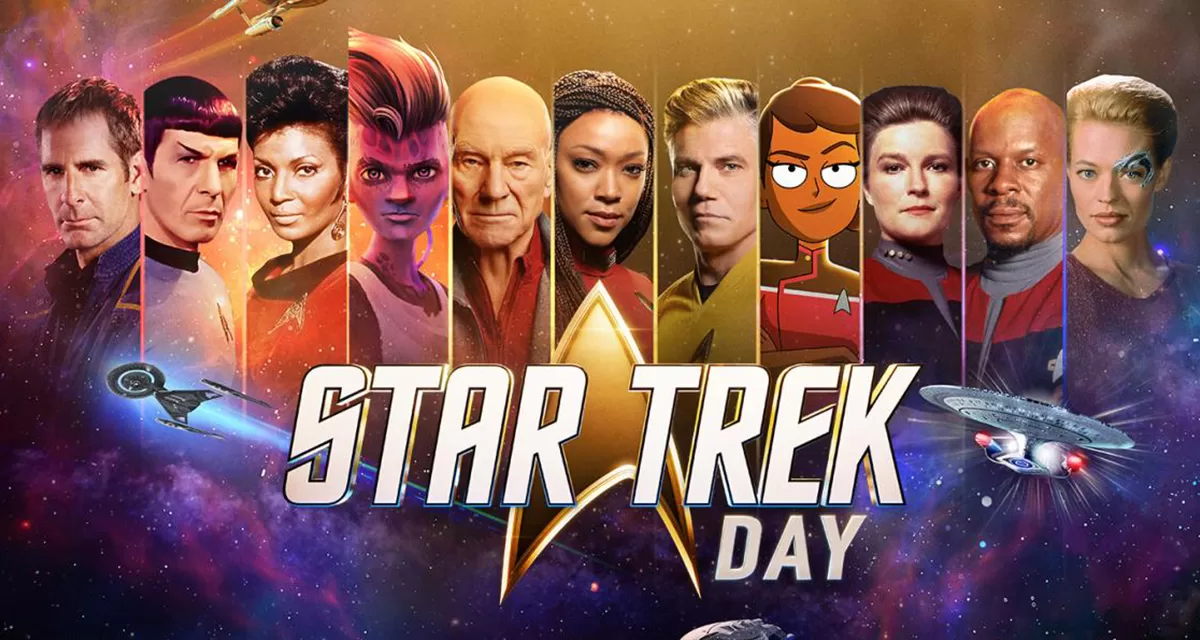
On Sept. 8, 1966, Star Trek debuted for the first time on television with “The Man Trap.” On that day, Star Trek creator Gene Roddenberry introduced audiences to a world that championed diversity, inclusion, acceptance and hope.
Today, in celebration of this year’s Star Trek Day, it was announced that the 60th celebrations will officially begin in January 2026, featuring notable partnerships, new launches and memorable moments throughout the year.
And, frankly, we are unashamedly here for it. Star Trek begins its countdown year to its 60th anniversary.
NBC aired that first episode on September 8, 1966 (the world premiere was broadcast two days earlier, in Canada). Besides William Shatner as Captain James T. Kirk, the show also featured actors DeForest Kelley as Dr. Leonard “Bones” McCoy, Leonard Nimoy as first officer Spock, whose mother was Human and whose father was Vulcan.
“You could characterize Star Trek as being outlined in Greek drama: A hero’s got to solve a problem and get back home,” says Shatner, now 95, one of the last living main cast members from the original series. In an interview with NPR earlier this year, Shatner related that the show’s creator, Gene Roddenberry, had been inspired by a TV show about a wagon train going West — only his show would be set in space…a Wagon Train to the Stars.
“They made a pilot and then NBC saw it and said, ‘we don’t like the script, we don’t like the cast, but we like the idea,'” Shatner recalls.
That’s when comedy legend Lucille Ball stepped in. Her production company, Desilu, had produced the pilot. Shatner says she was instrumental in getting it a second pilot. Nimoy was the only actor to return, and Shatner was cast as Captain Kirk.
“I saw this magical world,” Shatner recalls. “They took themselves a little seriously, you know, ponderous a little bit here and there. So my contribution may have been: let’s add some humor.”
But after its third season, the network canceled the series. With John & Bjo Trimble heading a now historic letter writing campaign, Star Trek fans rallied to return it to the air. Star Trek gained a crucial third season, without which it would never have gone into syndication, and we would not know of it today. Instead, the show continued its popularity, leading to prequels, sequels on TV, in motion pictures and in animation, an impressive litany of video game titles, innumerable podcasts and vlogs, and fan fiction.
The original series from the ’60s tried to show us the amazing technology the future had in store. Much of that has provided the inspiration for now commonplace things we have today. The flip-phone was inspired by the communicator from the show. iPads came from the data padds from Star Trek: Deep Space Nine. Tricorders inspired all sorts of modern handheld medical diagnostic devices, so sophisticated that some can read minute variances in your surface temperature and map out veins, reprojecting this information directly back onto your skin for the doctor to see. The ship’s computer aboard the Starship Enterprise featured artificial intelligence which dazzled then, but which strikes us as rudimentary and halting now.
The show was frequently and unabashedly used as a vehicle for social commentary. One episode in 1968 is credited with showing the first interracial kiss on television, between Captain Kirk and Lieutenant Uhura, played by Nichelle Nichols. Another depicted a civilization run by Nazis. Another showed us a clear commentary on the idiocy of racism. It showed the last surviving members of a planet with two races, each black on one side and white on the other, but clashing over which one was superior — the one who was white on the left side, or the one who was white on the right side.
60 years later, he says society still has much to learn from the Star Trek philosophy, which Roddenberry often talked about.
“We believe that the often-ridiculed mass audience is sick of this world’s petty nationalism and all its old ways and old hatreds. There is an intelligent life form out on the other side of that television tube,” Roddenberry said on an album recorded in 1976, “The whole show was an attempt to say that humanity will reach maturity and wisdom on the day that it begins not just to tolerate, but to take a special delight in differences in ideas and differences in life forms.”
Gene Roddenberry died in 1991. His wife, Majel Barrett, who played Nurse Chappell on the original series, died in 2008. They’re survived by a son, Rod, a TV producer and CEO of Rodenberry Entertainment.
Future Star Trek
There are no new Star Trek TV shows currently in production, but there is a new movie in the works. At the 2026 San Diego Comic-Con, writer/director duo Jonathan Goldstein and John Francis Daley talked about how they plan to reboot the franchise.
“The script is in progress and we’re very excited about it,” Daley said.
Goldstein added, “It won’t be the characters that you’ve seen previously, and I think it will probably be a little further into the future than we’ve been before. Our hope with this is to satisfy the fans, but also bring people in who may not consider themselves lovers of Star Trek, and surprise them.”
The 60th anniversary celebrates “Space for Everybody,” extending an open invitation to celebrate the future that Star Trek aspires to – a future of hope, a future of exploration and a future where we rise to the challenge of securing our best possible future. The message is one of joy. We can be a better species, a better citizen of the galaxy, if we choose to be.
In an age when darkness fills our politics, it is easy to forget who we truly are. Where we go from here is still very much up to us. The future is bright, yes, but it’s forged not of massive trusses and plates of unobtainium, but of the billions of tiny links in the chain of humankind. We can have the future we want, but it will take all of us to get there.
Peace, and long life to you. Life long and prosper.
Happy Star Trek Day from all of us at SCIFI.radio.

SCIFI.radio is listener supported sci-fi geek culture radio, and operates almost exclusively via the generous contributions of our fans via our Patreon campaign. If you like, you can also use our tip jar and send us a little something to help support the many fine creatives that make this station possible.