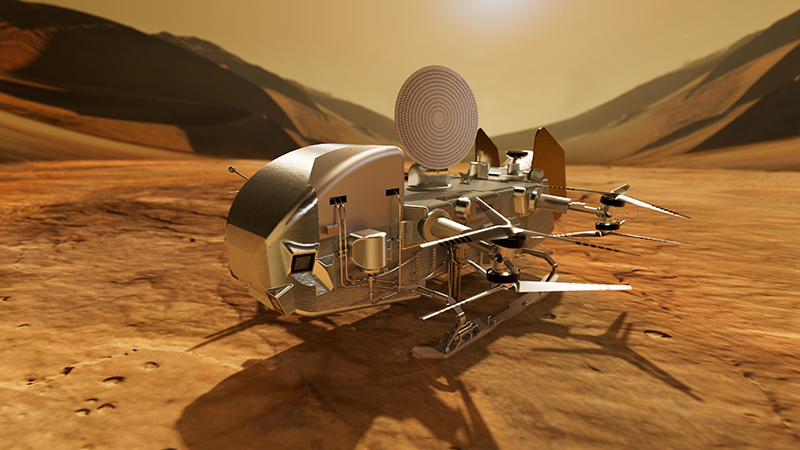
NASA’s Dragonfly rotorcraft now has its scientific eyes, as engineers finished installing
DragonCam, a set of seven science cameras, on the car-sized aircraft. The work took place
at the Johns Hopkins Applied Physics Laboratory (APL) in Maryland, where Dragonfly is
being assembled. Once it reaches Titan, Saturn’s largest moon and one of the most
intriguing worlds in the solar system, the rotorcraft will fly from site to site, and these
cameras will be its main way of seeing the landscape below.
Titan is a brutal place for electronics, with surface temperatures near -179 °C (-290 °F), far
colder than anywhere on Earth. To cope, the cameras, built by Malin Space Science
Systems, sit inside protective housings lined with a special insulating foam. This keeps the
delicate hardware warm enough to work while the world outside stays deeply frozen. It is a
small but crucial detail for a mission built to operate in such a cryogenic environment.
Each of the seven cameras has its own job, and together they cover everything from the
distant horizon to a single grain of sand. Two face forward, one wide-angle and one medium-
angle, and together they create a stereoscopic 3D view of the terrain ahead. Two side-facing
cameras stitch together wide panoramas of the surroundings.
Two more cameras point downward to judge whether the ground is safe for landing and to
help position the seismometer and the DrACO sample-collecting drill. The seventh is a high-
resolution microscopic camera that zooms in on sand grains just millimeters across near the
drilling site, giving scientists a close look at what Titan’s surface is made of and how it may
have formed.
Titan’s night is long, lasting nearly eight Earth days, and without artificial light the cameras
would be nearly blind, so DragonCam brings its own. A set of LEDs spanning infrared to
ultraviolet wavelengths illuminates the nearby surface when the sun is down. That lighting
lets the cameras capture natural-color images, showing the ground as the human eye would
see it. Ultraviolet light adds another trick: it makes organic molecules glow through
fluorescence, offering clues about the carbon-rich chemistry that could hint at how life’s
ingredients form.
Dragonfly is still taking shape, but the pieces are coming together. Months ago, it received
two navigation cameras, and over the coming months engineers will add more instruments,
including spectrometers and the DrACO drill. The mission’s official schedule calls for launch
in July 2028. After a long journey through space, the rotorcraft is expected to arrive at Titan
in late 2034, ready to start exploring a moon unlike anywhere else in the solar system.