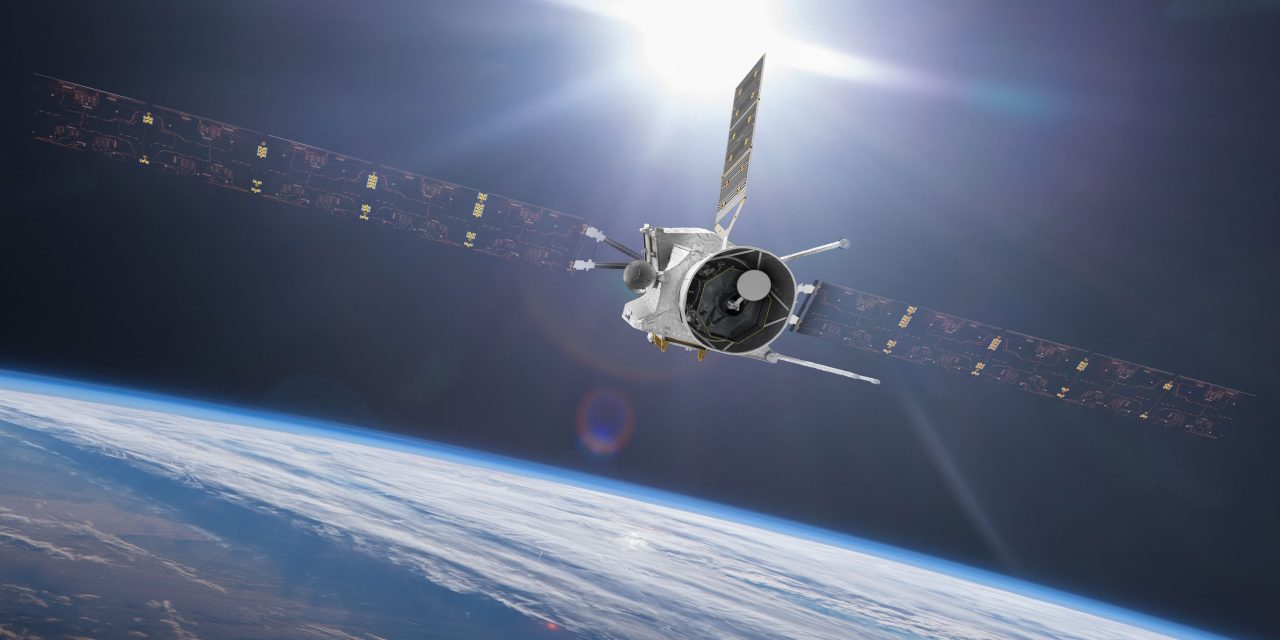
Artist’s impression of the BepiColombo spacecraft cruising in space with its solar arrays deployed. Image credit: ESA/ATG medialab
Europe and Japan’s BepiColombo mission reached Mercury on November 21, 2026, eight years after leaving Earth. The arrival was not clean. ESA’s mission control center in Darmstadt, Germany, confirmed the orbit on November 23.
The orbit insertion burn began at 18:24 UTC. Partway through, a software fault shut the thrusters down early and put the spacecraft into safe mode. By then the engines had delivered about 77 percent of the planned braking, and that was enough for Mercury’s gravity to capture the probe. ESA says the fault involved attitude and thruster control. Engineers are still investigating.
Not since NASA’s MESSENGER ended its mission in 2015 has a spacecraft orbited Mercury. Only two missions, Mariner 10 and MESSENGER, had visited before, which leaves Mercury the least explored rocky world in the Solar System.
BepiColombo launched from French Guiana in October 2018 and covered more than nine billion kilometers. It is named for Giuseppe “Bepi” Colombo, the Italian mathematician who worked out the gravity-assist routes Mariner 10 flew in the 1970s.
Getting to Mercury is notoriously hard. The planet sits relatively close to Earth, but the Sun’s gravity accelerates anything heading inward, so the spacecraft had to brake along the way. It did that with nine flybys: one of Earth, two of Venus and six of Mercury. Each pass bled off speed and reshaped the trajectory. A drop in power to its solar electric thrusters in 2024 pushed the arrival back from 2025 to November 2026, but the spacecraft was not damaged.
Built jointly by ESA and JAXA, the spacecraft carried its two probes stacked together for most of the eight-year trip, which protected the instruments and let them share power and propulsion.
The European probe, MPO, will map Mercury’s craters, analyze surface minerals, hunt for water ice in the permanently dark polar craters and study the planet’s huge iron core. The Japanese probe, Mio, will study Mercury’s active magnetic field and how the solar wind batters the planet. Two probes in two different orbits should give scientists their clearest look yet at how the planet works.
At Mercury’s distance from the Sun, sunlight hits roughly 10 times harder than on Earth, and surface temperatures swing from above 430 °C (806 °F) in daylight to minus 180 °C (minus 292 °F) at night. The spacecraft relies on layered ceramic insulation, titanium heat shields and solar panels that tilt to avoid overheating.
The two probes will separate on December 9, and Mio will move into its own elliptical polar orbit. On December 16, MPO will release the sunshield that protected Mio during the trip. MPO should reach its final orbit in March 2027, with routine science starting in April. Data from the two orbiters will also help astronomers model how rocky exoplanets behave when they circle close to their stars.