One Light-Day From Home: Voyager 1 Crosses a Threshold
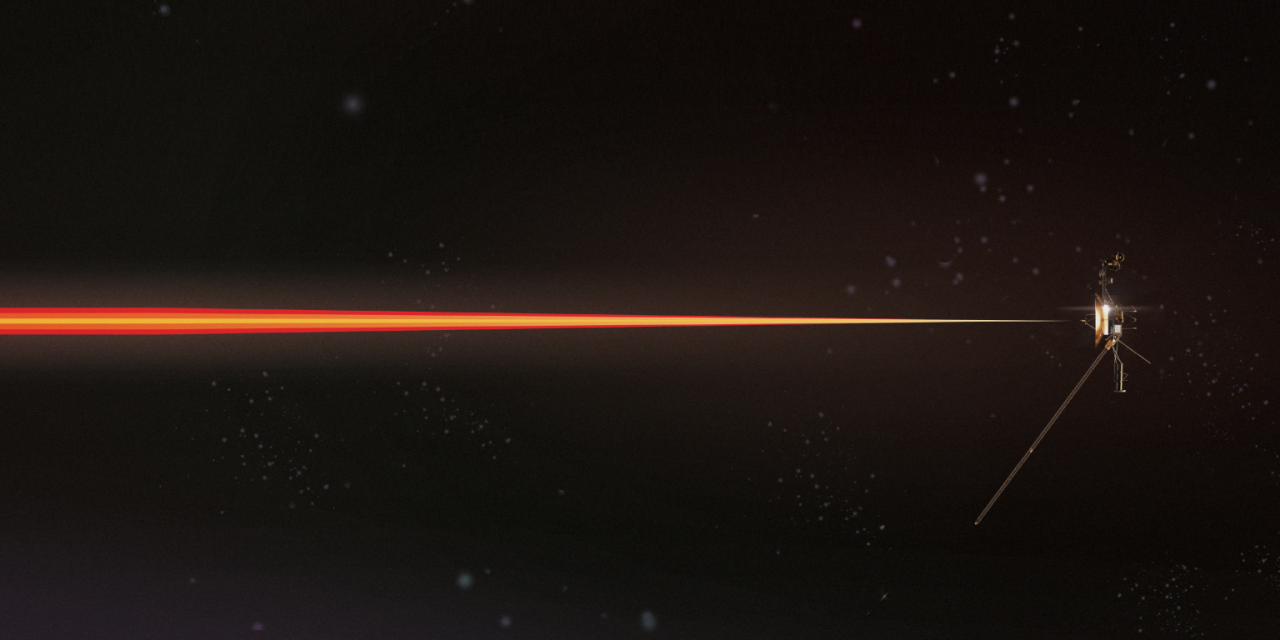
At 2:16 a.m. Pacific time on Wednesday, November 18, 2026, a small spacecraft built in the 1970s quietly became the first human-made object to sit one full light-day from Earth. Nothing happened on board. No alarm went off, no confetti dropped, and it played no fanfare. Voyager 1 just kept going at about 38,000 miles per hour, as it has for almost half a century. Back here, though, the moment meant a lot.
One light-day is the distance light covers in 24 hours: about 16.1 billion miles, or roughly 173 times the distance between Earth and the Sun. Light from the Sun reaches us in about eight minutes. It needs a full day to reach Voyager. The trip took Voyager 1 forty-nine years, two months and eleven days.
The Long Way Out
Voyager 1 launched on September 5, 1977, a few weeks after its twin, Voyager 2. Both were built to use a rare alignment of the outer planets that comes around once every 176 years. Mission planners called it the Grand Tour. That was a very ’70s name for a very ’70s idea: slingshot from one giant world to the next and see everything.
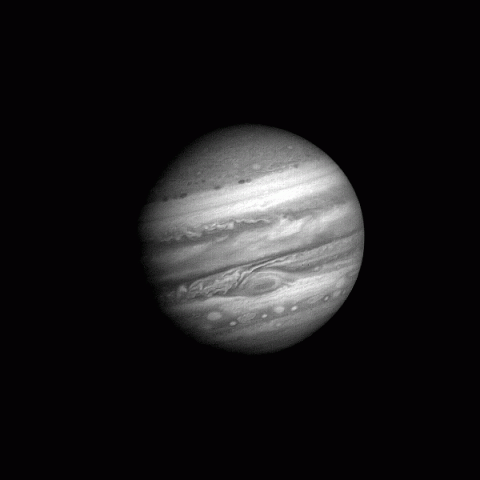
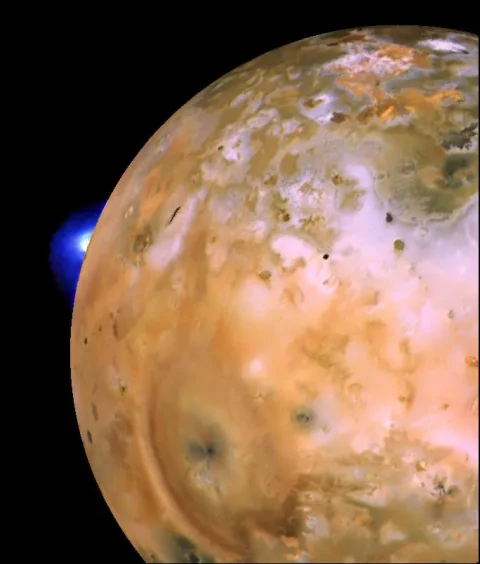
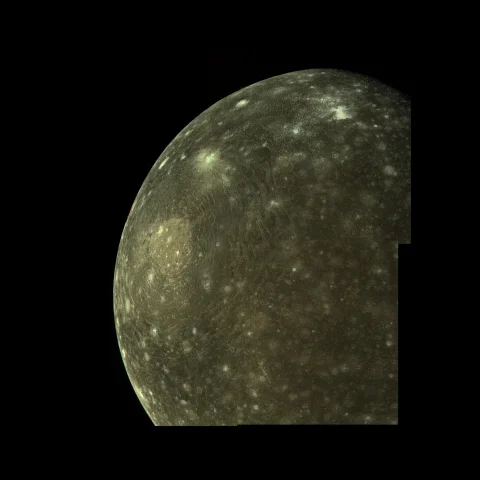
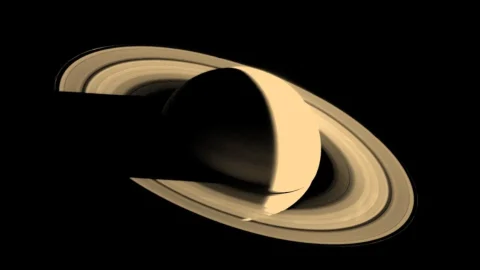
Voyager 1 reached Jupiter in 1979. It sent back the first close-up images of the planet’s storms and found active volcanoes on the moon Io. That was the first volcanic activity anyone had seen on another world. In 1980 it passed Saturn and made a close flyby of Titan, whose thick orange haze hid the surface. The Titan flyby threw Voyager 1 up and out of the plane of the planets, so the Grand Tour went on without it. Voyager 2 continued alone to Uranus and Neptune, and it is still the only spacecraft to have visited either one.
On February 14, 1990, at Carl Sagan’s urging, Voyager 1 turned its camera back toward home and took a family portrait of the solar system. In one frame, Earth shows up as a single pixel caught in a scattered sunbeam. Sagan called it the “Pale Blue Dot,” and the image has made more people stop and think about our place in the cosmos than any lecture could. Soon afterward the cameras were switched off for good to save power. There was nothing left out there to photograph.
(Image credit: NASA/JPL)
In August 2012, Voyager 1 crossed the heliopause, the edge of the bubble the Sun’s wind blows around the solar system. It became the first human-made object in interstellar space. It is out among the stars in the most literal sense, and it carries a gold-plated copper record of Earth’s sounds, music and greetings. Sagan described the record as a “bottle” thrown into the “cosmic ocean.”
What a Light-Day Means in Practice
For the engineers at NASA’s Jet Propulsion Laboratory, the milestone isn’t poetry. It’s a scheduling problem.
Every command now takes 24 hours to reach the spacecraft, and every reply takes another 24 to come back. If you send an instruction on Monday morning, you learn whether it worked on Wednesday morning. Voyager project manager Suzanne Dodd says the team listens to the spacecraft every day and sends commands once a week. They talk to it through NASA’s Deep Space Network, giant dish antennas in California, Spain and Australia. At this distance, Voyager’s 23-watt transmitter (about the power of a refrigerator bulb) reaches Earth as a signal billions of times weaker than a digital watch battery.
A 48-hour round trip leaves no room for improvising. When something breaks, and on a 49-year-old spacecraft things break, the team can’t react live. They diagnose problems from old telemetry, write fixes against decades-old documentation, and wait two days to find out whether they’ve saved the mission or ended it.
They’ve done it again and again. In late 2023, a fault in one of the onboard computers turned Voyager 1’s data stream into gibberish. Engineers traced the problem to a single bad memory chip and moved the affected code elsewhere, one piece at a time. Clean engineering data came back in April 2024. In 2025, residue was building up in the fuel lines of the thrusters Voyager 1 had been using. The team brought back a set of roll thrusters that hadn’t worked since 2004, a fix NASA staff called a “miracle save.” The spacecraft is still giving them trouble. NASA said this week that it has received no science or engineering data since November 14. Engineers confirmed the light-day crossing using Voyager’s carrier signal, the faint radio tone the spacecraft keeps transmitting, and are now working out what went wrong.
Running on Fumes
Voyager’s power comes from radioisotope thermoelectric generators, which turn heat from decaying plutonium into electricity. Their output drops about 4 watts every year. By this spring they were making less than half the power they produced at launch.
So NASA has been switching instruments off one by one, the way a starship crew shuts down decks to keep life support running. In April 2026 the team turned off Voyager 1’s Low-Energy Charged Particles experiment, which had measured ions, electrons and cosmic rays since launch. Of the ten instrument sets the spacecraft launched with, only two are still on: the magnetometer and the plasma wave subsystem. NASA expects to keep the current instruments running at least through the 50th anniversary of launch next summer, and hopes to keep at least one going into the 2030s.
Why It Matters for Science
Voyager 1 is the only working instrument we have in interstellar space, along with its twin. Everything we know first-hand about the medium between the stars comes from these two probes. Every model of that boundary region has been checked against them, and quite a few have been corrected by them.
The spacecraft have also produced surprises. “One big surprise is the extent to which our Sun continues to affect interstellar space,” says Voyager project scientist Linda Spilker. Even beyond the heliopause, Voyager 1 still picks up pressure waves and magnetic disturbances that started at the Sun. The edge of the solar system turns out to be a broad, messy region, more like a coastline than a wall. That matters for anyone who ever hopes to send something farther. Every future interstellar probe, from laser-driven light sails to whatever comes after them, will be designed using what Voyager measured on the way out.
The milestone also says something bigger. As Bill Nye has pointed out, most people alive today were born after the Voyagers launched. These machines were designed with slide rules and early computers, and they have outlasted the careers of many people who built them. They show what curiosity backed by sound engineering can do.
Still Going
Science fiction fans know this story already. In Star Trek: The Motion Picture, a fictional Voyager 6 comes back after centuries, so changed and so powerful that it threatens Earth while it searches for its creator. The real Voyager 1 won’t come back. Its signal will eventually fade, and it will drift on as a silent ambassador. It reaches one light-day from the Sun on February 4, 2027, and two light-days in 2075. In roughly 40,000 years it will pass within about 1.6 light-years of a star in the constellation Camelopardalis.
Voyager 2 will reach its own light-day milestone in November 2035, if it is still talking to us by then.
For now, Voyager 1 is still out there, a full day’s journey for light, sending a faint signal back to the planet that launched it. Next time you look up at night, remember the message going out and the reply coming back, each taking a full day. The universe may always hold more mysteries than answers, but Voyager 1 is still out there helping us make sense of the cosmos.

President of Krypton Media Group, Inc., radio personality and station manager of SCIFI.radio. Part writer, part animator, part musician, part illustrator, part programmer, part entrepreneur - all geek.