I have been reading comic books for more than fifty years. I have watched characters rise, fall, die, return, change identities, and reinvent themselves. Sometimes those changes are inspired. Sometimes they are ridiculous. And sometimes they reveal something about the people making those decisions that I would rather not have learned.
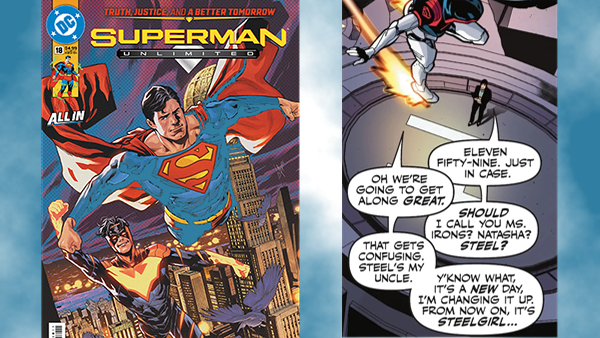
Enter Superman Unlimited #18, written by Dan Slott. Two characters in the Superman family are getting new identities. Both are stepping away from famous predecessors. Both want to establish themselves on their own terms. One gets a thoughtful reinvention. The other gets called a girl.
Let’s talk about that.
The Tomorrow Man
Jon Kent gets a new identity. He no longer wants to be defined by Superman or the Superman family. He wants to strike out on his own as The Tomorrow Man. Longtime Superman readers will recognize the name as a clever riff on one of Superman’s classic Silver Age monikers, The Man of Tomorrow.
Subversive. A cool name that still connects Jon to the Superman family, even if he wears a mask and pretends he doesn’t know anyone wearing an S. It recognizes his heritage while acknowledging his desire to become something different. It is respectful of Superman’s history. It gives Jon room to grow. It acknowledges that a son need not be a carbon copy of his father.
Well done.
Name Change: 8/10.
STEELGIRL?
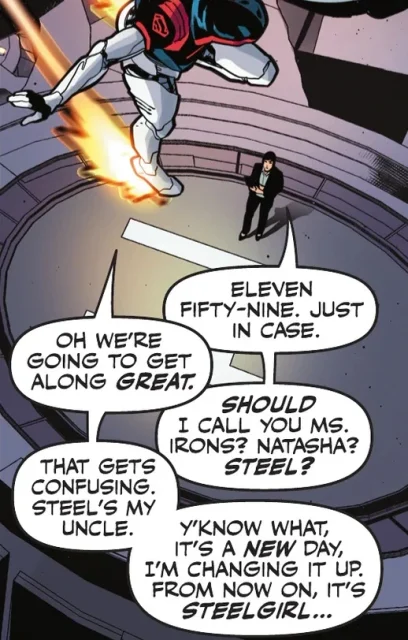
Natasha Irons gets a new identity. She wants to step out of her uncle’s shadow and establish her own organization.
For more than two decades, Natasha has been associated with Steel, having taken up the mantle of her uncle, John Henry Irons. The original Steel derived his name from another of Superman’s famous monikers, The Man of Steel. John Henry Irons was himself an extraordinary character. A brilliant Black engineer, he created sophisticated powered armor that allowed him to stand among superheroes. His name was also a reference to John Henry, the legendary Black steel-driving man who challenged a steam-powered machine.
The mythology was already there. The human being who challenged the machine. The engineer who mastered the machine. And then his niece, who could take everything he learned and build something even greater. Natasha has spent decades developing into a formidable superhero, engineer, inventor, and businesswoman. She is not a teenager auditioning for membership in a superhero club, à la the Legion of Super-Heroes.
She is a professional. She is an innovator. She is THE BOSS. She is choosing her destiny. And Dan Slott has her rename herself…
STEELGIRL?
GTFOH!
Name Change: 0/10.
The Writer Knew What He Was Doing
Here’s where the decision becomes particularly aggravating. In the comic, Natasha arrives at Hammer Space, a new subdivision of Steelworks in National City, where she will oversee operations. She has an assistant. She has a facility. She has resources. She has authority. She is preparing to develop her own ideas and establish herself independently of her uncle’s reputation.
Everything about the scene tells us Natasha Irons is an accomplished adult assuming command of her professional future. Then she announces her new superhero identity.
Steelgirl.
Even her assistant, Tomika Mori, questions the decision. “Steelgirl? Really?”
Natasha’s response? “Hey, no one questions Supergirl.”
Really? Sigh. Here is where continuity matters even if writers don’t want to acknowledge it, knowing the history of a character matters, even with a throwaway line like that.
Supergirl questions her moniker of Supergirl. Kara Zor-El has spent years navigating her relationship to Superman, her own maturity, her identity, and her place in the world. She simply hasn’t permanently resolved what to do about the name. Since DC holds the Supergirl trademark, I don’t see the publisher giving it up. But they could have named someone else Supergirl and let Kara Zor-El finally get her own name.
Natasha Irons began her superhero career as Steel. She already had an adult superhero identity. She already demonstrated her capacity to carry that mantle for decades of publication time. First appearing in 1994 as John’s niece, she later took up the mantle after John was injured while wearing the Entropy Aegis armor in 2003. She has been part of the DC Universe for more than three decades and has used the Steel identity since 2003, twenty-three years ago. Why would she regress to a juvenile designation precisely when the narrative is celebrating her independence?
But wait. It gets worse. Slott follows the exchange with Natasha declaring: “I’m not a girlboss, I’m…” And the next panel delivers the punchline: “THE BOSS.”
So the writer understands the problem with the term girlboss. He recognizes that Natasha’s professional authority requires no diminutive qualification. She’s not a girlboss. She’s the boss. But when it comes to her superhero identity, suddenly girl is acceptable? How does that work? You cannot simultaneously celebrate a woman’s maturity and independence while insisting that her newly chosen heroic identity should emphasize her status as somebody’s junior counterpart.
At least not without explaining why. And pointing at Supergirl is not an explanation. It’s an excuse.
There Were Better Names
This wasn’t a difficult creative challenge.
Steel is a metal alloy. Natasha is an engineer whose genius involves materials science, technology, fabrication, and the manipulation of physical systems.
Call her ALLOY. (Yes, I know about the Metal Men’s fusion identity, but when was the last time you saw it?) An alloy combines elements to create a material whose properties can exceed those of its individual components. Steel is an alloy, but not every alloy is steel. There’s your metaphor. Natasha honors her uncle’s legacy while establishing that her abilities, knowledge, and ambitions are not limited to his accomplishments.
Or call her AEGIS. An aegis is a protective shield, a symbol of guardianship. It’s an excellent superhero name for a woman who intends to apply her technical genius to protecting the world. It’s also a callback to the Entropy Aegis armor which gave her the opportunity to be Steel.
Either choice would give her an identity rooted in her abilities, her profession, and her personal philosophy. Neither requires pretending she’s twelve. And those are just two possibilities. The point isn’t that Alloy or Aegis must be the answer. The point is that there were answers. A professional comic-book writer with decades of experience, working for one of the largest comic-book publishers in the world, had the opportunity to redefine a thirty-year-old Black female superhero.
And the best he could apparently come up with was adding girl to her uncle’s name. That’s not a lack of available mythology. That’s a failure of imagination.
You want the final insult? Toyman is interviewing to work at Hammer Space in their research and development department. Do you know what he shows up to work wearing? A toy. A robotic doll we recognize as an alter ego for the Toyman. He shows up with his resume on an Etch A Sketch. But he gets to be a MAN, even as he shows up in the form of a diminutive, cherubic android.
Why This Matters
Because history doesn’t disappear merely because the story is printed on colorful paper. Black women have spent generations fighting to have their competence, intelligence, professionalism, and authority recognized. They have been called girls while occupying positions of responsibility.
Their accomplishments have been minimized. Their expertise has been questioned. Their authority has been qualified by people who would never consider speaking the same way about their male colleagues. To make matters worse, this is happening during a period when Black women are experiencing significant economic and professional upheaval in the United States. Federal employment cuts, attacks on diversity initiatives, and broader labor-market instability have disproportionately affected Black women. Hundreds of thousands have experienced job displacement or employment losses in recent years.
Against that backdrop, the language we use to recognize Black female achievement is not an inconsequential matter. I’m not suggesting a comic book caused those conditions. I’m saying that a comic book exists within those conditions. Just because minority characters were not meaningfully represented during the Golden and Silver Ages did not mean there weren’t heroic individuals who deserved representation. And when a major entertainment publisher tells a story about an accomplished Black woman finally exercising her independence, the choice to call her Steelgirl deserves scrutiny.
Particularly when the same comic gives a young white male superhero an identity suggesting destiny, possibility, and the future. Jon Kent gets Tomorrow Man. Natasha Irons gets Steelgirl.
One character is allowed to grow beyond his inherited identity. The other is linguistically returned to a subordinate position within hers. That contrast should bother people. It certainly bothers me.
The Problem Isn’t Change
I want to be perfectly clear about something. I am not opposed to what Slott is doing with Natasha Irons. Quite the opposite. It’s about damn time. Shuri could use the competition. It’s about time Natasha got greater independence. It’s about time she was recognized as a technological innovator in her own right. It’s about time she was allowed to build something outside her uncle’s shadow.
I welcome all of it.
My problem is that Slott did almost everything necessary to establish her independence and then undermined the achievement with an infantilizing name. And he did it in the same story where Jon Kent gets a considerably more thoughtful reinvention. This is why I find the argument that Slott is the professional writer and therefore knows better so tiresome. Being assigned a character doesn’t automatically mean you understand that character.
Having your name on the cover doesn’t mean your creative decisions are beyond criticism. I have been writing for decades. I have studied comics history, literary criticism, characterization, and narrative structure. I know the difference between an effective reinvention and one that contradicts the very character development it supposedly celebrates.
This was a failure of imagination across the entire publishing process—from the writer to the assistant editor to the editor who signed off on it. That’s the part that should bother DC most: not that one writer made a questionable call, but that no one in the chain flagged it. A sensitivity reader would have caught it. The fact that no one did is the story.
The Failure of Imagination
Science fiction and superhero comics possess an extraordinary freedom. Their creators can imagine impossible technologies, alien civilizations, alternate histories, and entirely new ways of organizing human society. They can make human beings fly. They can create sentient machines and build civilizations among the stars.
But somehow, imagining an accomplished Black woman whose new superhero identity doesn’t reduce her to a girl is a bridge too far?
Tomorrow Man gets the marquee. Steelgirl gets the speech balloon. Even the visual storytelling tells us whose transformation deserves to be celebrated.
Come on. There is something profoundly disappointing about watching a medium capable of imagining almost anything remain constrained by such ordinary cultural prejudices. Especially when the writers and publishers have the institutional resources, historical knowledge, and professional experience to recognize the problem.
Natasha Irons doesn’t need to be grateful for the opportunity to become Steelgirl. She’s already been Steel. She earned her place. The story should recognize the woman she has become, not repackage her as a junior version of the man whose legacy she has spent thirty years honoring.
John Henry Irons was the man called Steel. Natasha Irons should be allowed to become the Woman of Whatever the Hell She Chooses. If the best the creative team can do is Steelgirl, perhaps the problem isn’t the character. Perhaps the problem is the limitations of the imagination being brought to her.
The Answer-Man has spoken.
Final Score: Tomorrow Man, 8/10. Steelgirl, 0/10. They didn’t even try.


Thaddeus Howze is an award-winning essayist, editor, and futurist exploring the crossroads of activism, sustainability, and human resilience. He's a columnist and assistant editor for SCIFI.radio and as the Answer-Man, he keeps his eye on the future of speculative fiction, pop-culture and modern technology. Thaddeus Howze is the author of two speculative works — ‘Hayward's Reach’ and ‘Broken Glass.’