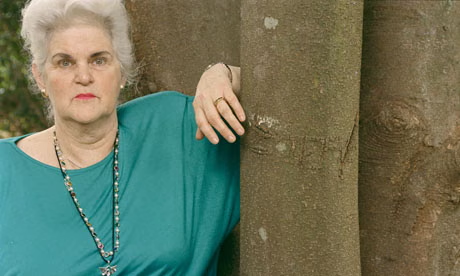
Today, April 1st, 2026, marks the 100th birthday of Anne McCaffrey. Born in Cambridge, Massachusetts she went on to become one of the most beloved science fiction and fantasy authors in history.
Anne McCaffrey was the first woman to win a Hugo Award for fiction, taking home the prize in 1968 for Weyr Search, the novella that would become the foundation of Dragonflight and, eventually, the entire Dragonriders of Pern series. The following year, she became the first woman to win the Nebula Award for fiction as well, for Dragonrider. Remember the time: in those days it wasn’t very welcoming to women either as authors or protagonists, but McCaffrey not only opened that door but held it open for everyone coming behind her.
What she built was truly remarkable.
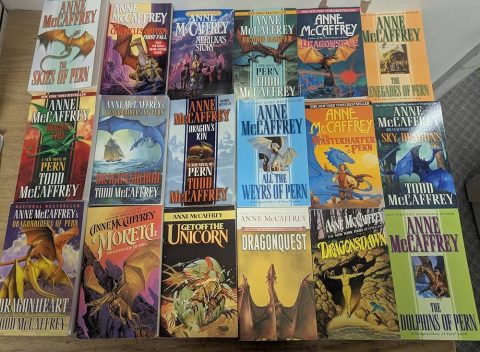
Pern is, depending on how you’re feeling when you ask the question, either science fiction or fantasy. McCaffrey herself was clear on the matter: it’s science fiction. The dragonriders of Pern bond with genetically engineered creatures descended from a native species called fire lizards, modified centuries before the books take place by colonists from Earth. The existential threat they face, Thread — a mindless, voracious organism that rains from the sky at regular intervals — is explicitly extraterrestrial, following an elliptical orbit on the neighboring Red Star. McCaffrey built the science underneath the mythology with care, even if most readers were simply falling in love with dragons and the extraordinary young woman who rode the gold queen Ramoth.
That young woman — Lessa of Ruatha Hold — is worth pausing on. She is not a passive heroine waiting for rescue. She survives years of brutal servitude through sheer cunning, masks her identity, manipulates everyone around her, and maneuvers herself into position to claim what was stolen from her. By the time she Impresses Ramoth on the hatching ground, she’s already the most formidable person in the room. McCaffrey gave us female characters who acted, who had ambition and intelligence and edge, at a moment in popular fiction when that was far from guaranteed.
She wrote about a hundred books in her time with us, most of which I have to confess I have not read, but one stood out for me, and that was The Ship Who Sang, published in 1969. That book’s protagonist was a child born with severe physical disabilities, whose brain is symbiotically integrated into a starship’s computer. Helva, the ship-brain of the XH-834, is one of the most quietly devastating protagonists in SF. The title story, in which Helva’s partner Jennan dies and she grieves at the controls of her own hull, tests the boundaries of what it means to be human. I’ve read thousands of books, but this one holds a special place for me.
McCaffrey moved to Ireland in the 1970s, eventually settling into a house she called Dragonhold-Underhill in County Wicklow, and by all accounts embraced Irish life wholeheartedly. She was a horsewoman, passionate about music — the Harper Hall series wasn’t accidental — and by reputation a warm and generous presence at conventions and for readers who reached out to her. She passed away at her home in November of 2011.
She transformed the genre in ways that still resonate today. I’m grateful you were with us, Ms. McCaffrey. In the creation of so many worlds of fantasy and science fiction, she changed the one she lived in, and we are all the better for her having been in ours.