I. The stress points of Frameworks
Most writing students are taught to begin with structure: Save the Cat, The Hero’s Journey, The Three-Act Paradigm. These frameworks have become the catechisms of modern storytelling, taught as if they were gospel rather than postmortem.
They promise that if you strike the right beats, your story will sing. That if you follow the pattern, you’ll replicate the magic.
But that’s not how story works.
The Way It’s Been Done is Coming to and End.
It was inevitable.
In a world permeated with media, only meaning can save the industry from its inevitable glut of product with no one willing to engage it. These models are not formulas of creation; they are fossils of recognition, afterimages of narratives that already succeeded.
This is why you get that feeling when a new movie type starts to trend. You will see a host of different films trying to replicate the energy of the new resonant field being tapped, a connection to the audience, something they are hungry for.
They describe what happens when meaning congeals, not how it emerges. Teaching them as creative law is like teaching chemistry by describing the smoke after the reaction. It tells you nothing of the transformation, only what it looked like when it was done.
We Have To Level Up Our Game
Stories are not clocks to be wound. They are living systems — thermodynamic, self-correcting, constantly reorganizing themselves around moments of equilibrium between chaos and clarity. What these frameworks miss is that no two writers, and no two audiences, see the same arrangement of meaning in the same way.
And we are learning that what was once respectable in one era is problematic in the next. It is impossible to create a film with no societal flaws, because well, where is the fun in that? Part of the appeal of media is the exploration of parts of ourselves through media experiences, learning about things we might not otherwise know exists, except through this bizarre method of information distribution.
II. Story as Constellation
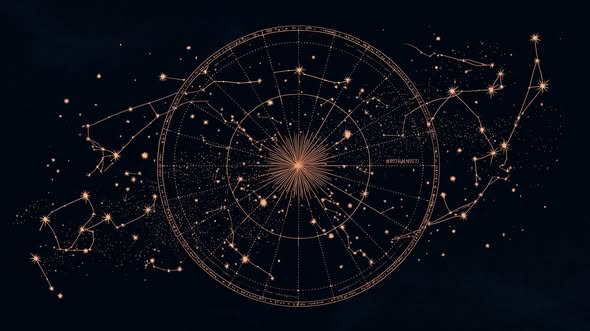
A story is not a line. It is a night sky. Each idea, theme, or trope is a star, some old and dying, some newly born. When we write, we chart these stars into constellations of meaning. But constellations are not real.
They are projections, agreements of perception.
What we call Orion from one vantage point may look like a serpent or a ladder from another. The stars do not move; we do. Or rather our perspective does. We learn to move our minds through multiple layers of meaning. That’s the secret of great storytelling: it allows multiple configurations to remain true. A single narrative can be tragedy, comedy, myth, or metaphor, depending on the observer’s angle. The difference between a trope and a truth is parallax — the shift in meaning as you change your perspective.
Frameworks like Save the Cat teach one constellation, one strong configuration of stars that promises if you don’t deviate too much, people will see what you want them to see. But they cannot teach you how to see new shapes in the sky, or how to connect disparate lights into new patterns that no one has yet named. And that, ultimately, is the art of it.
III. The Schelling Point of Story
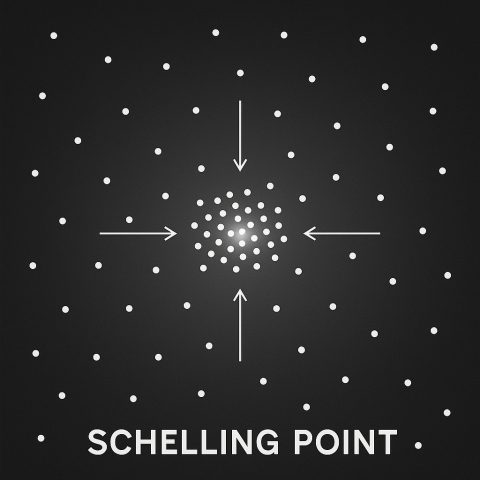
In game theory, a Schelling Point is a solution people converge upon without communication—a shared point of focus that feels inevitable. In narrative, the Schelling Point is that gravitational center of coherence around which all interpretations orbit.
Every good story functions as a Schelling Point of Meaning. The writer, the reader, the critic, the actor—all are drawn toward the same invisible nexus, even if they describe it differently. The story is not just the text; it’s the field of attraction where disparate perspectives recognize one another’s gravity.
When a story achieves this, it ceases to be formula and becomes phenomenon. Think of the Rashomon effect—how Kurosawa allows a single event to splinter into multiple truths, yet still feel unified. Or the Spider-Verse films, which assemble infinite variations of a myth and yet orbit the same emotional truth: anyone can wear the mask.
The Schelling Point is the opposite of prescription. It’s a dynamic equilibrium, the magnetic moment when chaos self-organizes into pattern and every observer says, Yes, that’s what it means, even if they can’t agree on the wording.
IV. The Death of Novelty and the Birth of Pattern
In an era where tropes replicate faster than ideas, we mistake repetition for resonance. TVTropes has cataloged the narrative genome down to the molecular level—archetypes, reversals, beats, motifs—yet none of these tell us why they work.
There are no new stories, we say. But that isn’t the death knell of creativity—it’s its condition of rebirth. There are no new stars, but there are always new constellations. When a writer understands story as a Schelling Point, originality no longer depends on inventing new matter but on perceiving new structure. The same elements can be reconfigured into infinite arrangements of meaning.
The task of the writer is not to escape the known tropes but to orchestrate them differently, to create a gravitational center strong enough that readers from different worlds—cultural, emotional, ideological—still find alignment in the dark.
V. The Practice of the Schelling Story
To teach story this way is to teach awareness over obedience.
Ask not What happens next? but What becomes understood next?
Don’t count beats; identify convergences.
Seek the moment where emotion, theme, and event synchronize—where the reader, no matter their vantage, feels the pull of inevitability.
A Schelling Point story sustains multiple readings because it’s built around a shared tension that transcends its architecture. It’s not about pacing—it’s about phase transition, the moment the system reorganizes itself into meaning. That’s the point every culture calls myth, every civilization calls art, and every great writer seeks to touch.
Vi. The Theory’s Core Truth
The most important idea in the theory is simple:
A story is not a formula to follow but a Schelling Point of shared understanding—a living pattern that reveals different constellations of meaning depending on where you stand.
This principle redefines story as a participatory field, not a closed mechanism. It rejects the idea that narrative structure can be standardized, because what gives story life is its interpretive multiplicity. You can teach the beats, but not the gravity. You can label the tropes, but not the orbits they form.
What we call mastery is not formula—it’s fluency in pattern. The great writer doesn’t memorize constellations. They make new ones, knowing someone, somewhere, will still look up and say, I see it too.
VII. Epilogue: The Hand at the Source Wall
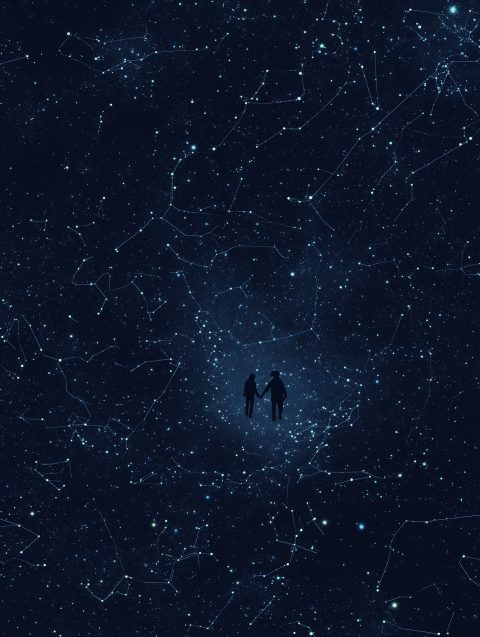
And somewhere beyond the edges of imagination, a hand of fire writes across the firmament:
Destroying your world today: There are no new stories. However: There are new constellations, if you imagine ideas as stars. That’s the Schelling Point of Story — the recognition that meaning isn’t made by novelty, but by perception. Every story that matters is an act of alignment between scattered lights, and every writer who understands that is not following a formula. They’re building a universe.
Coda: The Hardest Part of the Craft
This is the part no one tells you.
The Schelling Point of Story cannot be diagrammed, outlined, or templated. It can only be heard, like the faint harmonic that vibrates when truth and emotion strike the same chord. You can’t teach it as formula — you can only teach people to become sensitive to resonance.
Structure and trope are visible craft; Schelling-level resonance is felt craft.
It emerges when a writer learns to ask not “What’s the plot?” but “What is the human truth this story bends toward, no matter who reads it?” That question is the doorway to universality. It shifts the writer’s focus from sequence to significance, from causality to coherence.
The writer stops chasing beats and starts tuning meaning — aligning every scene, line, and silence toward the gravitational truth that makes all interpretations orbit the same invisible center.
This is how the apprentice becomes the artisan.
They stop forcing stories to follow them and begin to follow the story — listening for that low hum of inevitability when the work begins to think for itself.
They lose themselves in the story, no longer counting beats or clinging to prescribed turning points. They begin to hear the field itself: the living pattern, the resonance that tells them they’ve found something worth orbiting.
And that, finally, is how universes are made.

Thaddeus Howze is an award-winning essayist, editor, and futurist exploring the crossroads of activism, sustainability, and human resilience. He's a columnist and assistant editor for SCIFI.radio and as the Answer-Man, he keeps his eye on the future of speculative fiction, pop-culture and modern technology. Thaddeus Howze is the author of two speculative works — ‘Hayward's Reach’ and ‘Broken Glass.’