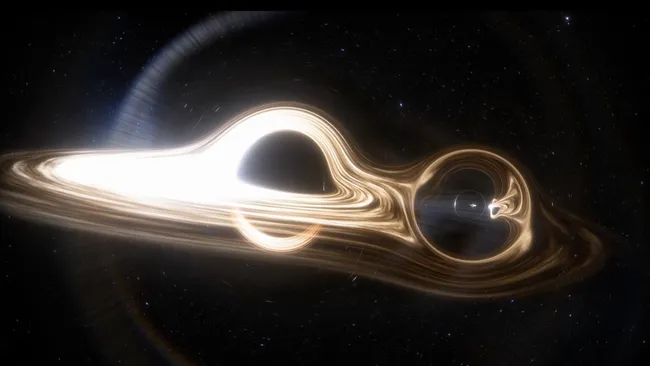
For the first time ever, astronomers have imaged two black holes orbiting each other, finally offering visual proof for the existence of black hole pairs (with the caveat that we might just be looking at one big blazar instead of two of them). Faint fluctuations of radio light captured by both ground and space based telescopes showed a pair of black holes locked in a 12-year orbit some five billion light-years from Earth.
The scales involved are almost beyond human comprehension. The larger of the two black holes is producing a cosmic fountain known as the blazar OJ287, and it’s a supermassive scar in the face of the cosmos with a mass roughly 18 billion times more massive than our own sun.
The second black hole is much smaller, spitting out a jet of near-light speed particles twisting around like a rotating garden hose or a dog’s wagging tail, a shape being created by the resistance of the newly ejected particles encountering the mass of previously ejected ones, a bit like drizzling syrup on pancakes. The researchers published their findings Oct. 9 in The Astrophysical Journal.
“For the first time, we managed to get an image of two black holes circling each other,” study first author Mauri Valtonen, an astronomer at the University of Turku in Finland, said in a statement. “In the image, the black holes are identified by the intense particle jets they emit. The black holes themselves are perfectly black, but they can be detected by these particle jets or by the glowing gas surrounding the hole.”
Black holes are born from the collapse of giant stars. Their gravitational pull inhales gas, dust, stars and other black holes. Some of them inhale so much so fast that the inward-bound material generates friction, which causes it to heat up and emit light that telescopes can detect, turning them into so-called active galactic nuclei (AGN).
The most extreme AGN are quasars — supermassive black holes billions of times heavier than our own sun. Their accretion can’t all fall into the event horizon at once, due to simple mechanical crowding, but the gravitational pull is so strong that the leftover mass is spun into tornadoes of energy that shoot out light blasts trillions of times more luminous than the brightest stars. When these jets are pointed toward Earth’s line of sight, they are known as blazars.
Astronomers have previously imaged the supermassive giants at both the center of our galaxy and in the nearby galaxy Messier 87. Gravitational wave detection gives evidence for black hole binaries, yet despite long-held suspicions that OJ287 contained an orbiting pair, telescopes lacked the resolution to separate them from a single dot.
Observations of OJ287 go back before astronomers even knew black holes existed; its semi-periodic flares in intensity were included in late 19th century photographic plates made during astronomical observation by telescope. Data from these plates and subsequent observations led astronomers to begin speculating in the 1980s that the system’s regular dimming and brightening was caused by two orbiting black holes.
To get the visual proof, the astronomers used a radio image obtained by a network that includes the RadioAstron, or Spektr-R, satellite — a Russian scientific satellite carrying a radio telescope operational from 2011 to 2019.
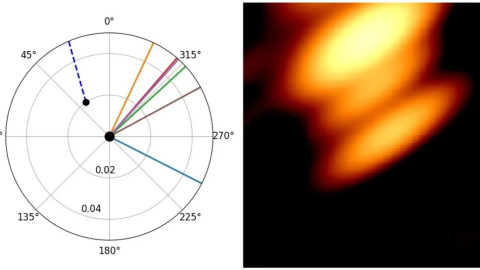
“The satellite’s radio antenna went halfway to the moon, which greatly improved the resolution of the image,” Valtonen said. “In recent years, we have only been able to use Earth-based telescopes, where the image resolution is not as good.”
Comparing the features in the image to past calculations, the researchers distinguished two components corresponding to the jets of each black hole appearing exactly where the theory suggests they should. Still, the two jets in the images could be overlapping ones, suggesting that there might still be only one jet, so admittedly, they’re mostly sure, but it’s not dead certain that’s what we’re seeing.
“When the resolution close to that provided by RadioAstron is achieved again, in the future… it would be possible to verify the ‘wagging of the tail’ of the secondary black hole,” they wrote.

SCIFI.radio is listener supported sci-fi geek culture radio, and operates almost exclusively via the generous contributions of our fans via our Patreon campaign. If you like, you can also use our tip jar and send us a little something to help support the many fine creatives that make this station possible.